
On the Common 187
Three serious reasons and one jokey one.
Hi everyone,
I’m sure you’re quite tired of my weather reporting, but indulge me: this week we in Charlotte saw the biggest snowfall we’ve had since 2004. That means it was the biggest one since we’ve been here. It was beautiful, magical, and restful. And since I was finally well—I was sick during the ice storm—I could really enjoy it.
Isn’t snow an interesting idea? Just the right mixture of humidity and temperature, and the world turns bright white, just for a few hours. It’s spectacular1.
The Part Where There’s an Essay: Why Do Women Prefer Printed Bible Studies?

A few months ago, a young engaged man asked me about a tendency he noticed in his fiancée, as well as other women in his life. He noticed that the women in our church preferred to study the Bible using some kind of publication alongside, whereas the men he knew were more comfortable opening their Bibles alone. He asked me why I thought this was; I fumbled through a few reasons off the top of my head. Here’s what I told him, plus some other thoughts:
Reason one: Marketing. Most estimates from the Christian booksellers marketplace put the percentage of the market being majority female at around 60%. Women do the research, the shopping, and the buying in this market. So if a publisher markets their book for women (maybe by slapping a flower on the cover or having an introduction written by a female author), they can plan on it appealing to the larger share of the customer base. Just open up any major Christian publisher’s website, and you’ll find an appeal to the female customer, whether that be through marketing of fiction (they buy 80% of those books) or non-fiction. Publishers are hoping to get a good return on investment by appealing to the largest share of their customers.
Reason two: Women like to get an A. This is my own incidental observation, but many women I know struggle acutely with people-pleasing. They are afraid of getting the wrong answer. So having a guidebook in front of them is reassuring; they can do a little bit of homework, searching the Scriptures, and then feel relieved when their answers match the “correct” ones.
To further prove the point, I will tell you one of the most common phone calls I used to field in my days in customer service at a Christian publisher. We sold a line of simple Bible study workbooks with a “leader’s guide” at the back of the book. We did not sell an alternate version of the book for “not-leaders,” without that guide inside. One version only.
We’d often hear from Bible study leaders who called to complain about this setup, because the women (it was ALWAYS women) would just flip to the back of the book to reference the leaders’ guide so they could fill in the “right answers.” To be clear: these were not just observation-type questions. They were also “look at your life and heart” kind of application questions. But the users wanted to get the right answer.
(My answer to these callers was always a bit anemic: “Tell them not to do that.” Use a stapler? Rip the pages out? Do we really need these preschool levels of accountability to get adults to do their own homework? Don’t answer that.)
Reason three: Women are implicitly told they need this help. Here’s the rub for me. In the midst of these two answers comes reason number three: sometimes it’s implied that women need remedial help. How does this suggestion come to us? In the form of the books that are marketed to us.
I can’t tell you how many times I’ve looked at a theology book for women which is (a) shorter, (b) prettier, of course, and (c) easier than the equivalent marketed to men. Why is a theology book for women one-quarter the size of the book for men? Maybe it’s just my personality or my upbringing, but I regard this as worthy of suspicion. It seems to be implicitly sending the message that the ladies can’t handle the heavy lifting. What’s in the boys’ books, and why can’t we read them?
In reality, the “boys’ books” are just theology books, and they are meant for everyone. The existence of the second category (“women’s theology”) is unnecessary in my mind.
I understand that there are women who will not pick up a theology volume but who might pick up the shorter, prettier one. The publishers wouldn’t make them if they didn’t sell. What is more, many people benefit from them. But I wonder: if we took this category of books out of the picture, which would happen: more women would explore the more difficult resources (because there were not other options)? Or fewer women would read any theology at all?
That’s my attempt at an explanation from three decades of observing adult life in evangelical church circles. Of course, it could be a fourth explanation, said only half in jest by my better half, “maybe the men are just lazy and don’t want to do extra Bible study homework.” Maybe….
For the Anglophiles
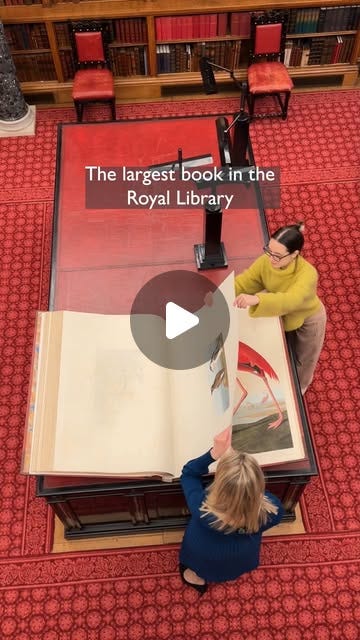
Beauty from a royal library:
Reads & Listens of the Week
A hearty amen to this article: The Generational Narcissism of Always Thinking We Face the Biggest Crisis Ever. “It’s true, today’s challenges are real. But not unrivaled. This is why the insistence that we face the greatest crisis ever reveals something less about the moment and more about ourselves.” (I think I’ve already said this here, but it bears repeating: if you want some perspective abour our current upheaval, The Rest Is History did a nice series on the 1960s that might help a bit.)
The Ugly Side of the Truth: “Beauty comes through pain, just as harmony comes through dissonance. The rising tension of a story makes it a good one. Things are beautiful when they resonate with the truth — even if that truth is sad.”
It should be said that the Nateland podcast has ended; this was a weekly “just-funny” listen for me since the days of Covid, when it started. The guys who co-hosted with Nate are rebranding under the podcast name Public Figures.
I think most of you know that I’m a subscriber to The Dispatch. I find it a good use of my news-consumption money. Their recent roundtable episodes have been very good, and they’re free for anyone.
Of a sane man there is only one safe definition. He is the man who can have tragedy in his heart and comedy in his head.― G.K. Chesterton
Having once lived in a place where it is still snowing in April, I understand that some of you might not be quite so enthusiastic about it.
"Why Do Women Prefer Printed Bible Studies?" It's a great question, and I agree with your observations. I also think the relational and storytelling aspect of guided studies makes them attractive to women. They often include details of the author's personal history, anecdotes about their childhood, parenting, or life crises that relate to the Biblical text they're discussing. The warmth and relatability of those personal details make those studies feel comforting and inviting. Unfortunately, they can also discourage women from feeling confident enough to study the Word of God on their own, trusting the Holy Spirit to help them understand it.
Theology books can be difficult to read, depending on the author, but Scripture is so beautiful and clear! (And uniquely sacred and powerful!) I love seeing women experience an "aha" moment in inductive Bible studies when they see how the context, structure, or details of a passage shape its meaning.
That article from Trevin Wax is a good one. Thanks for linking.