
On the Common 197
Steinbeck, Hedgehogs, and Autism: This edition has it all

Good morning,
Our spring of 2026 was made up of travels to hither and yon, and I could not be happier that this season is coming to an end. Was it Chesterton who talked about how the real function of travel is to help us see the wonders of home properly? It’s nice to be here.
The Part Where There’s an Essay: Who the Jerks Are
On Friday night, after the graduation events concluded, there was a street festival in town. Tents lined the sidewalks, peddling replacement windows and outdoor furniture. The food trucks were stacked alongside one another: empanadas, kabobs, and Carolina BBQ.
The street was jammed with people: people in camp chairs happily staking out their place as they waited for friends; children with sticky palms holding the last of their popsicles and chasing their siblings; dads holding babies wearing tiny noise-canceling headphones, shielding them from the sounds around them. Dogs happily greeted every passerby, hoping for handouts.
As we made our way toward the stage, the band continued with their set of 90s R&B favorites. That’s when I saw him: a lanky man, mid-20s, facing away from the stage, jerkily moving his bent arms in time with the bass. His eyes closed as his arms slowly moved up away from his sides and out into the atmosphere, still bent at the elbow and moving in rhythmic circles. As the evening went on, it was clear that he preferred Béyonce to BBD, and even more apparent that he wasn’t familiar with Shania Twain at all.
He was stimming to the music, the term clinicians use to define the repeated motions that autistic people need to cope with sensory overload. This young man was right in the thick of it; he was clearly enjoying the music, but needed some repetitive motion to help him stay in it. His family and friends took no notice, carrying on with their singing and conversation. They occasionally checked in with him, seeing if he needed anything or wanted a beverage. Other than that, he was one of them—just responding a little bit differently to the music than everyone else.
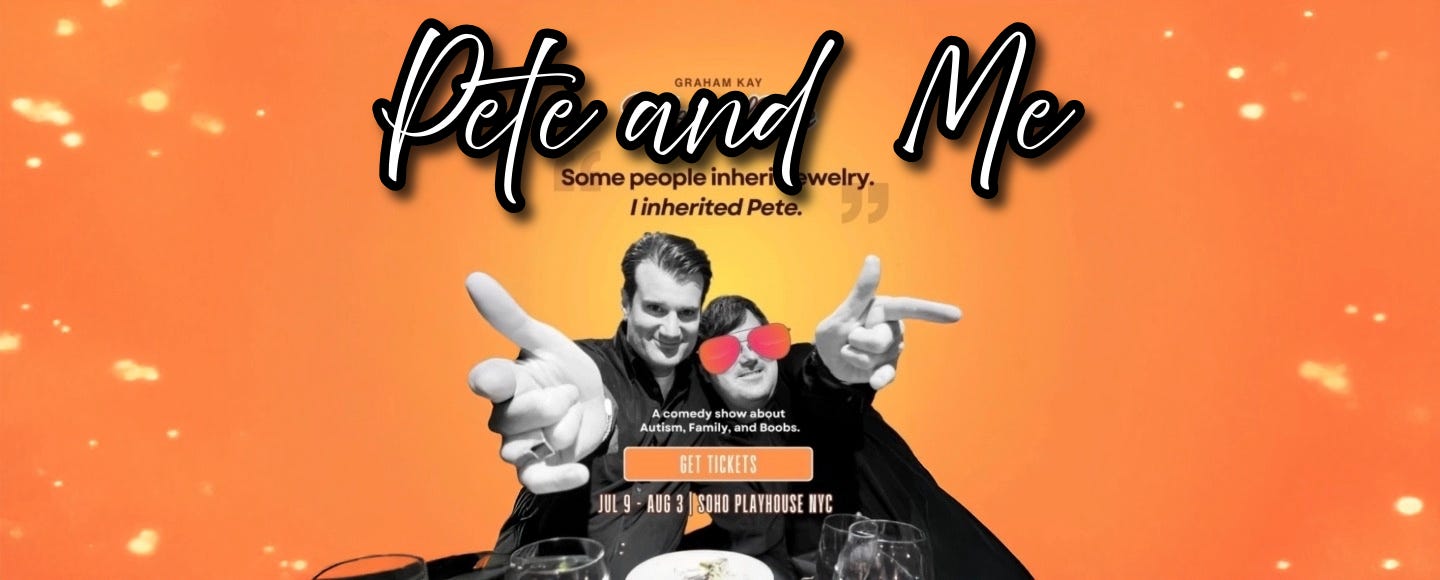
In his recent special Pete and Me, comedian Graham Kay introduces us to his older brother, Pete, a severely autistic man with a penchant for superheroes, among other things. Pete is the older of the two brothers. He calls Graham on the phone every day and impersonates Ernie from Sesame Street, expecting Graham to respond as Bert. He never tires of this. Graham admits begrudgingly that he does tire of it, and sometimes he doesn’t answer the phone.
I don’t often talk about it here, but one of the siblings in our group of five children is on the spectrum. This has obviously provided its own set of adjustments and trials as he has grown. He has had to learn the hard way; we have had to learn the hard way. We are all still learning, though I am grateful for the growth in all of us. As challenging as the late teen and early adulthood years are for every person, they are more challenging for the neurodiverse person. They are more challenging for the family of the neurodiverse person. We have attempted to weather all of this together and pray for good fruit.
We love his quirky obsessions and his brilliant memory. We all know that if we’ve forgotten a certain detail of a family story, he’s the one to ask. We have come to depend on him for it. He feels deeply, is passionate, and has tireless desires to do better in every arena of his life.
I see the reactions—the people who give one-word answers to him versus the ones who warmly take him in and ask him to say more. I feel the rejection on his behalf. I try not to judge the relative spirituality of the people interacting with him at church. He is a challenge conversationally; he gets a hold of a thread and doesn’t let it go. He might try asking you questions (he is learning), but he probably won’t hear your answer, because he’s preparing to say his next thing.
Some people learn this and navigate it with skill. They are the ones he returns to. Others struggle.
Late in his set, Graham Kay tells a story of his brother humiliating himself (and Graham) in a very vulnerable, very public way. Graham was thirteen at the time, and he was deeply ashamed. Instead of responding to help his brother, he hid. In that moment, he saw two friends come to Pete’s rescue instead. And then, he was even more ashamed that he had hidden.
Graham continues, “Maybe my brother does have a superpower. People like him teach society who the jerks are. They teach society, more importantly, who the helpers are.”
Having a child on the spectrum has taught me who the jerks are. It’s taught me who the helpers are. It’s also taught me how much jerk remains inside of me, versus how much helper. It often depends on the day.
Here’s more about Graham’s special. I recommend it, though there are portions not appropriate for the whole family.
For the Anglophiles
Legendary naturalist David Attenborough turned 100 last week, and the royals (and the wildlife) found a way to celebrate:
Reads & Listens of the Week
The National Park Service wants you to peek in on their sled dog puppies at Denali National Park. Here’s a webcam for you to enjoy.
Warren Cole Smith recently interviewed Nashville producer Ben Shive. Ben is so wise on topics of collaboration and creativity. This is a great listen for people in any walk of life.
Some specific complaints on the use of AI from an archivist. Feed Historical Manuscripts to the AI Bot? Think again. “I have never seen a machine that can transcribe a manuscript with anything close to the accuracy that an intelligent or trained human can. Why? Because a human can instinctively interpret what was intended to be a communication to another human. So even if we concede (which I don’t) the AI hucksters’ insistence that their machines can transcribe with close to total accuracy, they cannot even begin to approach understanding.”
The Book Club hosts did not agree on Steinbeck’s East of Eden, but I greatly enjoyed their conversation about it!

It is an uneasy lot at best, to be what we call highly taught and yet not to enjoy: to be present at this great spectacle of life and never to be liberated from a small hungry shivering self -- never to be fully possessed by the glory we behold, never to have our consciousness rapturously transformed into the vividness of a thought, the ardour of a passion, the energy of an action, but to always be scholarly and uninspired, ambitious and timid, scrupulous and dim-sighted.
George Eliot, Middlemarch
Your posts are so powerful! I needed this today. God bless you! 🙏☀️💛
"There's no place like home". It really resonates with me. As for the Jerks, and the Helpers, growth and learning, it is evident grace and truth operate generously in your home. Thinking about the National Parks and Denali, Jonathan and Katie had an opportunity to enjoy a dog sled ride there several years ago. I second your conclusion regarding AI too....Last but not least, Dad's original hat collection could certainly rival Ben Shives'.:) Great read.